
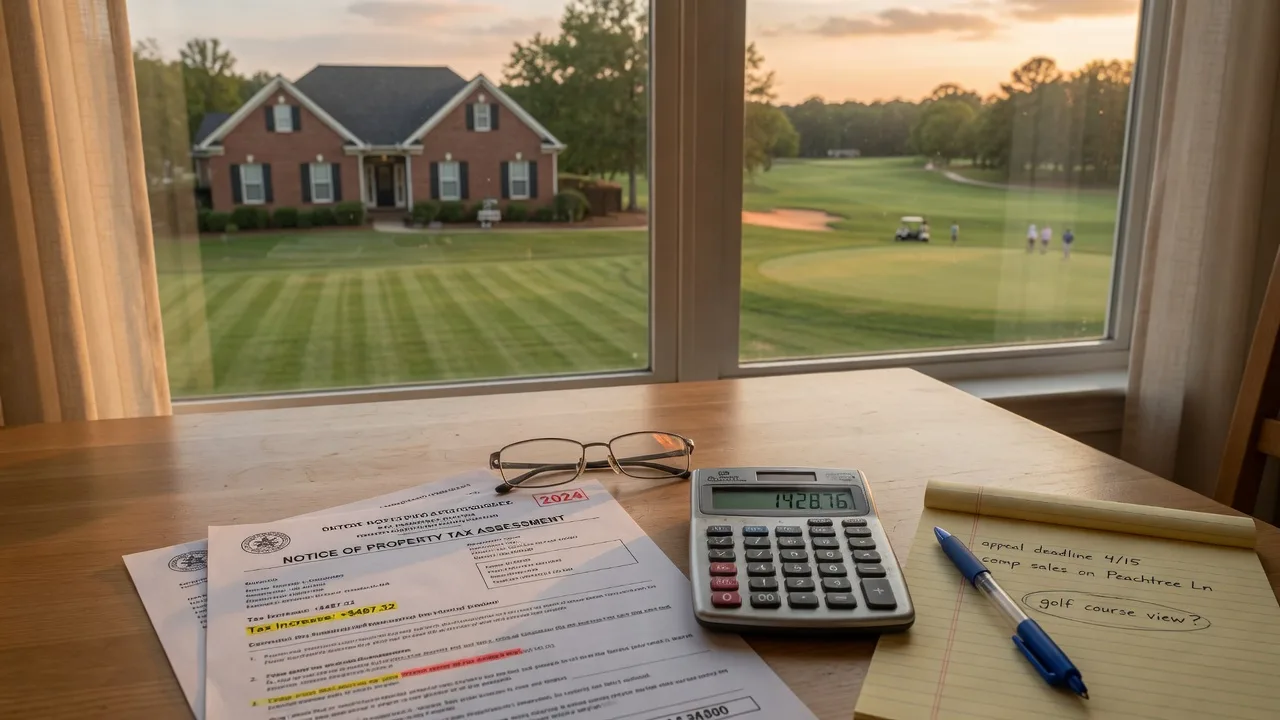
Hall County's Board of Commissioners has proposed a General Fund millage rate for tax year 2026 that comes in 14.12% above the state-calculated rollback rate, legally triggering a public notice of a property tax increase and three public hearings. The proposal has drawn attention from homeowners, buyers, and real estate professionals across Northeast Metro Atlanta who want to understand how the change affects their bottom line.
Lisa Harris, a luxury real estate specialist serving Hall County communities including Flowery Branch, Gainesville, and Oakwood, breaks down the proposal, explains the rollback millage rate rule, and compares Hall County's tax burden to nearby counties like DeKalb so you can make informed decisions about where to buy or sell.
What Is the Rollback Millage Rate?
Under Georgia law (O.C.G.A. 48-5-32.1), when property values rise due to reassessment, counties must calculate a "rollback" millage rate: the rate that would generate the same property tax revenue as the prior year using the current year's tax digest. If the county commission proposes a rate above the rollback, it is legally required to advertise a property tax increase and hold three public hearings, even if the majority of taxpayers would pay less because of cuts in other tax districts.
This is exactly what Hall County has done. The proposed General Fund rate exceeds the rollback, triggering the advertising and hearing process. However, the county has also proposed cuts in other tax districts, which means the net effect for most residents is an overall decrease.
The Proposed General Fund Increase
The Board of Commissioners' proposed General Fund rate represents a 14.12% increase above the state-calculated rollback. The increase is earmarked to fund additional court operations for Hall County's sixth Superior Court judge, which the state approved, including staffing and related expenses.
The current General Fund millage rate is 3.227 mills. The proposed rate above the rollback would fund these new court operations. But the headline number does not tell the whole story, because the county is also cutting rates in other tax districts.
Net effect by tax district:
- Unincorporated Hall County residents face a net decrease of 0.113 mills.
- Most incorporated city residents see a net reduction of 0.078 mills.
- City of Gainesville residents face a net increase of 0.302 mills.
The county confirmed that the Board of Commissioners has performed a full rollback of the General Fund rate in 11 of the past 12 years, making this year's above-rollback proposal an exception rather than a pattern.
The Hall County School Board Proposal
Separate from the county commission, the Hall County Board of Education has proposed a millage rate of 15.490 mills for 2026. This is 6.95% (1.006 mills) above the rollback rate of 14.484 mills and a 0.5-mill increase over the current rate of 14.990 mills. The school district cited a projected $9.8 million budget gap as the driver.
For homeowners, the school board's proposal has a larger impact on the total tax bill than the county general fund, because the school millage rate is roughly five times the size of the General Fund rate. The combined county and school rates determine the overall property tax burden.
How Hall County Stacks Up: The Brookhaven Comparison
For context, Hall County's total millage rate (unincorporated, including the school district) is approximately 23.81 mills. By comparison, Brookhaven in DeKalb County carries a total millage rate of roughly 46.33 mills, nearly double Hall County's rate.
Georgia assesses property at 40% of fair market value, so the effective tax rate on a home's market value is lower than the millage rate alone suggests:
- Hall County: Effective tax rate of approximately 0.95% to 1.01% of market value.
- Brookhaven (DeKalb County): Effective tax rate of approximately 1.14% to 1.16% of market value.
A homeowner in Hall County pays roughly half the millage rate of a homeowner in Brookhaven. This is a meaningful difference when you are comparing monthly housing costs across counties. For a $600,000 home, the difference in annual property taxes between the two counties can be thousands of dollars.
The gap is driven primarily by higher DeKalb County operations taxes (general, hospital, police, fire, bonds) and a higher school district millage rate. Hall County's lower tax burden is one of the factors that draws buyers from metro Atlanta and out of state to Northeast Metro Atlanta communities.
Why This Matters for Buyers, Sellers, and Homeowners
Property taxes are a fixed cost of homeownership that directly affects affordability, buyer qualification, and market positioning. Here is how the proposed increase matters across different scenarios:
For Buyers
Your lender factors property taxes into your debt-to-income ratio and monthly payment calculation. A higher tax bill means a lower maximum purchase price, even if your income and credit are strong. If you are shopping in Flowery Branch, Gainesville, or other Hall County communities, ask your lender to run the numbers with the proposed rate so you are not surprised at closing. And if you are comparing Hall County to Gwinnett or DeKalb, factor in the county-level tax difference: Hall County's lower millage is a real monthly savings.
For Sellers
A pending tax increase can affect buyer perception of affordability. If you are selling in a Hall County community, be prepared to answer questions about the proposed rate and the rollback process. Provide tax records from the current year and help your agent frame the county's lower overall tax burden compared to nearby metro Atlanta counties. Accurate disclosure of estimated taxes helps prevent your buyer from getting a surprise at closing.
For Homeowners
Even with the proposed increase, Hall County's total tax burden remains lower than many metro Atlanta counties. But you should still review your annual assessment notice carefully. If your home's assessed value jumped more than the market justified, you can file an appeal with the Hall County Board of Assessors. Also verify that you are claiming all applicable exemptions: the Georgia homestead exemption is the baseline, but Hall County and its cities may offer additional local exemptions or freezes for seniors, disabled veterans, and other qualifying groups.
What to Do Next
If you are a Hall County property owner or prospective buyer, here are the steps to take:
- Attend a public hearing. The county is required to hold three public hearings on the proposed rate. Check the Hall County website for dates and locations. This is your opportunity to speak directly to the commissioners about how the tax change affects you.
- Review your assessment notice. Make sure the county's valuation of your property is accurate. If you believe it is too high, file an appeal with the Hall County Board of Assessors before the deadline on your notice.
- Check your exemptions. Confirm you are receiving the homestead exemption and any local exemptions you qualify for. The Hall County Tax Commissioner's office can help.
- Talk to a Realtor. If you are buying or selling in Hall County, work with an agent who understands how property taxes affect pricing, buyer qualification, and closing costs. Taxes are not the whole picture, but they are a critical part of it.
Lisa's Take
Property tax proposals can feel alarming at first glance, but the headline rate is rarely the full story. Hall County's 14.12% above-rollback figure sounds steep, but when you factor in the cuts in other districts, most residents pay less than last year. What matters more is the long-term trend: the county has rolled back the rate in 11 of the last 12 years, and even with this increase, Hall County's tax burden remains well below DeKalb, Fulton, and Cobb. If you are considering a move to Northeast Metro Atlanta, the tax conversation is worth having early, but it should not be the deciding factor. The lifestyle, schools, and community you gain in Hall County far outweigh a modest tax shift.
Lisa Harris Can Help You Understand the Numbers
With nearly 20 years of experience across Northeast Metro Atlanta, including Hall County communities, Lisa Harris can help you factor property taxes into your buying or selling decision. She is also a resident of Apalachee Farms in Gwinnett County and understands the tax dynamics across both counties.
Information believed to be accurate but not guaranteed. Tax rates, millage rates, and assessment data are subject to change by the Hall County Board of Commissioners, Board of Education, and the Georgia Department of Revenue. Consult a licensed tax professional or the Hall County Tax Commissioner's office for official guidance on your specific property. Lisa Harris, Real Estate Agent, Georgia license #320847. REMAX Center, 1225A Tuscany Drive, Braselton, GA 30517.