
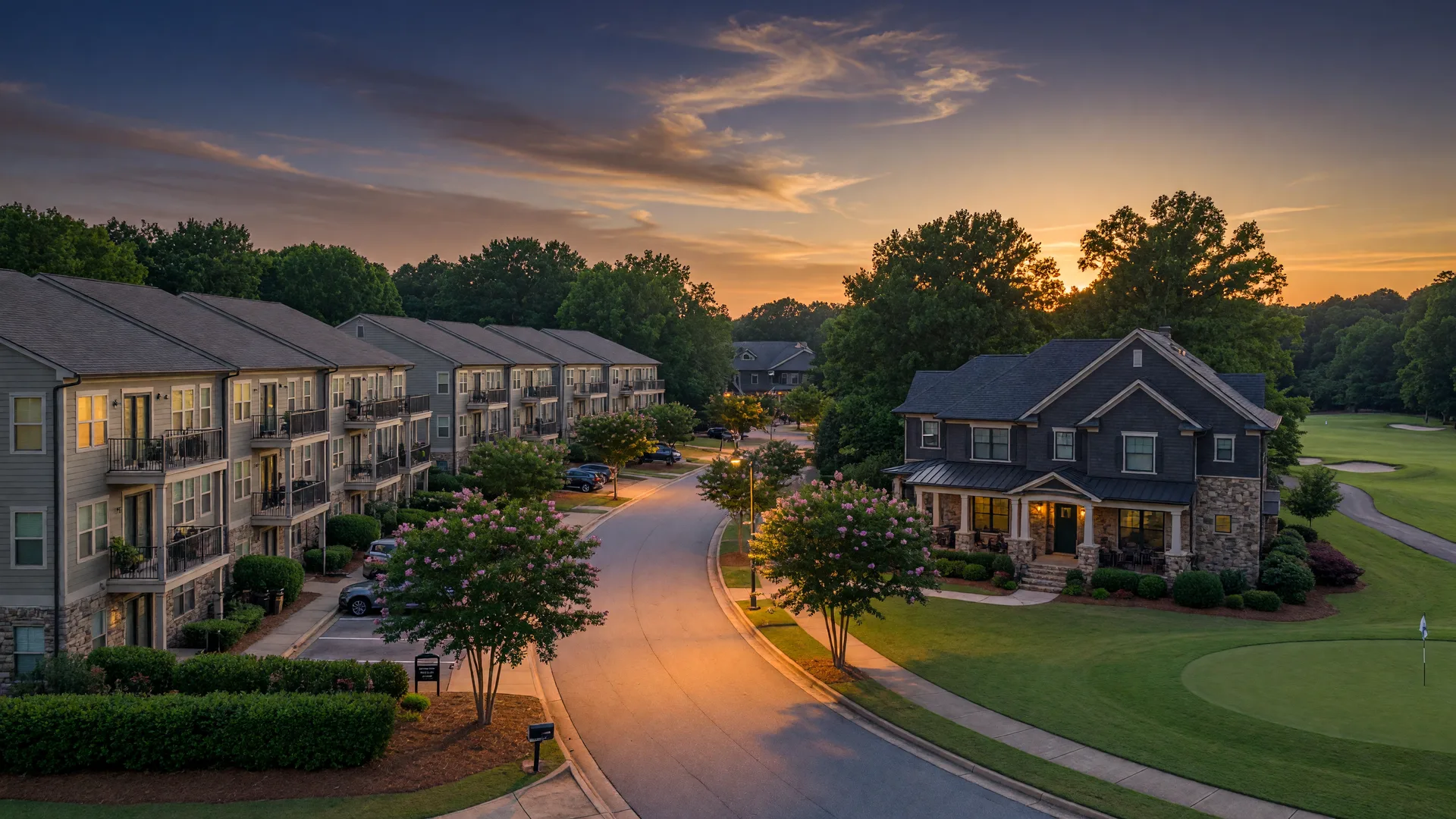
Is it cheaper to rent or buy a home in 2026? It is one of the most searched real estate questions of the year, and the answer changed: in metro Atlanta, renting now costs less than buying on a month-to-month basis, a reversal of the long-standing math that made ownership the cheaper choice. The driver is simple, elevated mortgage rates near 6.6% on top of record home prices.
As a luxury real estate specialist with 19 years in Apalachee Farms and Northeast Metro Atlanta, I run this comparison with buyers weekly. The honest answer is that renting wins in the short term and buying usually wins over time, and the crossover point matters more than any single monthly number. Here is the 2026 data and how to apply it to your move.
Where the Monthly Math Stands Right Now
Realtor.com's March 2026 analysis found that renting costs less than buying in all 50 of the largest U.S. metros, including Atlanta. LendingTree's February 2026 report put the median metro Atlanta gap at about $357 per month, with a median rent near $1,770. Rental Beast's Q2 2026 report measured an even wider gap, about $801 per month more for owners once taxes, insurance, and maintenance are included.
On a national scale, LendingTree found mortgaged owners pay about 36.9% more per month than renters, a median of $2,035 versus $1,487. Atlanta's gap sits on the smaller end, which is why analysis of the 50 largest metros ranks the region 85th of 100 for the size of the rent-versus-buy spread.
Before anyone reads those headlines and assumes renting is always smarter, know this: the same 2026 models put the typical buy-versus-rent break-even in Atlanta at about seven years. That is the time horizon where accumulated equity, a locked-in payment, and rent increases start to overtake the monthly savings from renting.
Median monthly gap between renting and buying in metro Atlanta, renting cheaper, LendingTree analysis February 2026
More per month buying costs versus renting in Atlanta, Rental Beast Q2 2026 report
Of the 50 largest U.S. metros where renting now costs less than buying, Realtor.com March 2026 analysis
Why the Math Flipped in 2026
For most of the last decade, buying was cheaper than renting in Atlanta. Low mortgage rates meant a monthly payment on a purchased home often undercut market rent for the same floor plan. That relationship inverted as rates climbed. At 6.64%, the payment on a median-priced Atlanta home now exceeds the rent on a comparable rental, and the gap is reinforced by home values that remain near record levels.
WSB-TV summed it up in a story that ran at the end of August 2026: "The math changed, and so should your strategy." That framing is exactly right. The change does not mean ownership no longer makes sense. It means the decision now depends heavily on your timeline, your down payment, and the local market, not on a blanket rule that buying always beats renting.
It also explains a quiet shift in behavior. More households are renting longer while they save, and more sellers are sweetening deals to compete for the same buyers. In Gwinnett County, homes take an average of 37 to 38 days to sell, inventory is up sharply, and seller concessions such as closing cost credits and rate buydowns have become routine. Those concessions quietly shrink the gap the headlines describe.
When Renting Is the Smarter Move
Renting is not a consolation prize. In this market it is a legitimate financial strategy for specific situations.
You may move within 3 to 5 years
If a job transfer, family change, or lifestyle shift is likely in the next few years, the closing costs, mortgage fees, and time it takes to build equity rarely pay back before you sell again. In that window, renting often wins on cash flow.
You are still building a down payment
The gap between renting and buying in Atlanta means a renter can save more each month. Parked in a high-yield account, that savings can become a 20% down payment faster than stretching to buy now at a 6.6% rate.
You want zero maintenance worry
A $415,000 home carries real upkeep: roofs, HVAC systems, appliances, and landscaping. Owners typically budget roughly 1% of home value per year for maintenance. Renters trade that uncertainty for a predictable monthly bill.
When Buying Still Wins the Long Game
The national headlines do not tell the whole story. ATTOM's 2026 study found that owning a three-bedroom home was more affordable than renting it in 57.7% of U.S. counties, and timeline-driven buyers in Apalachee Farms often land clearly on the ownership side of the ledger.
You plan to stay 7 years or more
A fixed-rate mortgage locks your housing payment for 30 years while rents keep climbing. Over a decade, the equity you build in a well-chosen home usually dwarfs the monthly savings the rent-versus-buy gap showed in year one.
You want stability in a community like Apalachee Farms
Golf course living, resort-style pools, tennis, and pickleball are the kind of amenities you really use over years, not months. Ownership anchors you to a community with only about 587 homes and a strong resale story.
The local math favors ownership in many price ranges
ATTOM's 2026 study found owning a three-bedroom home was more affordable than renting it in 57.7% of U.S. counties. Metro averages hide real differences, and in Northeast Metro Atlanta, seller concessions and rate buydowns shrink the gap further.
Do the Crossover Math Before You Decide
The break-even comparison should include closing costs, property taxes, insurance, HOA dues, and about 1% of home value per year in maintenance, weighed against expected rent growth and the equity you build each year. In Apalachee Farms, that is usually somewhere in the five-to-seven-year range for a buyer in The Terraces or Riverside, and often shorter in Clubview or The Oaks, where golf course lots historically hold value well. If your plan is to stay a decade, the monthly rent-versus-buy gap rarely matters as much as the decade of equity you would be giving up.
How This Plays Out in Apalachee Farms
Apalachee Farms homes range from about $500K to $1.3M across five sections: The Terraces, Riverside, Sterling Green, Clubview, and The Oaks. At that price level, the monthly rent-versus-buy gap is real, but so is the nature of the purchase. Buyers here are typically not deciding between a rental apartment and a first home. They are choosing between continuing to rent and securing a golf course lifestyle with resort-style pools, seven tennis courts, six pickleball courts, and a fitness center that their whole family will use for years.
The market is helping buyers close the gap. With homes taking more than five weeks to sell on average and inventory up about 50% year over year in Northeast Metro Atlanta, sellers are offering closing cost credits and temporary rate buydowns. A 2-1 buydown can cut the effective rate by roughly a point for the first two years, which can erase several hundred dollars of the monthly gap at the exact moment your budget is tightest. New construction incentives that buy down rates can do the same on a to-be-built home.
My advice to locals deciding rent versus buy: build the comparison around your real timeline, not the headline number. If you see yourself raising a family, playing golf, and swimming at the community pool here for the next decade, the math almost always resolves in favor of buying, and the search should focus on the section that fits your price point and lifestyle. If you are testing the area or expect a transfer, a year or two of renting while you save is a perfectly sound plan, and a great reason to have a local expert watching the market for you.

Lisa's Perspective on Rent vs. Buy
"This is the first year in more than a decade where I tell clients to actually run the rent-versus-buy math, because the answer is no longer automatic. But I also remind them that the decision is about more than the monthly payment. A mortgage is a forced savings plan. Every payment builds equity, and in a community like Apalachee Farms you are investing in a lifestyle with only about 587 homes and amenities people drive across the metro to visit. If your timeline is five years or more, I have never seen a client regret the purchase. If you are not sure, running a detailed comparison with a local expert is exactly what the off-season of the market is for."
Frequently Asked Questions About Renting vs. Buying
Is it cheaper to rent or buy in Atlanta in 2026?
On a month-to-month basis, renting is cheaper in metro Atlanta. LendingTree's February 2026 analysis put the median gap at about $357 per month, and Rental Beast's Q2 2026 report measured about $801 per month. Renting only wins in the short term though: buying still builds equity and locks in your housing payment, so the right answer depends on how long you plan to stay.
How long do I need to stay in a home for buying to pay off?
The commonly cited break-even for Atlanta is about seven years, based on 2026 models that weigh closing costs, taxes, insurance, and maintenance against rent growth and equity. If you expect to stay longer than that, buying is usually the stronger financial move. If your timeline is three years or less, renting typically comes out ahead.
Why did renting become cheaper than buying?
The flip is driven almost entirely by mortgage rates near 6.6% and record home prices. For most of the past decade, buying was cheaper than renting in Atlanta because rates were low. With rates more than double their 2021 lows, the monthly cost of financing a home now exceeds rent in most metros, a reversal analysts say is likely to persist while rates stay elevated.
Can seller concessions close the gap in Apalachee Farms?
Yes, and they are common right now. With homes taking 37 to 38 days to sell on average in Gwinnett County, sellers are offering closing cost credits and rate buydowns that lower your effective monthly payment by several hundred dollars. On a home in The Terraces or Riverside, those concessions can easily erase most of the rent-versus-buy gap.
Is renting ever the smarter choice for a future Apalachee Farms buyer?
For some buyers, yes. If you are new to Northeast Metro Atlanta and not sure which community fits, renting for a year while you learn the schools, commutes, and neighborhoods can be smart. You also preserve the option to buy when rates improve or when you have a larger down payment. I help a number of future residents do exactly that, and I stay in touch so they can move quickly when the right home comes on the market.
What about new construction incentives?
Builders are offering some of the strongest incentives in years, including rate buydowns and closing cost credits on to-be-built homes. When a builder buydown gets your effective rate below the market rate, it can tip the monthly math back in favor of buying. The trade-off is a build timeline and a location outside an established community like Apalachee Farms, so compare carefully.
Not Sure Which Way the Math Points for You?
Lisa Harris combines nearly 20 years of Apalachee Farms market knowledge with current mortgage rate data and a clear-eyed view of the rent-versus-buy trade-off. Bring her your timeline and down payment and she will help you build a plan that fits your numbers.
Lisa Harris, MBA, CLHMS GUILD
Lisa Harris is a CLHMS GUILD Certified Luxury Home Marketing Specialist serving Apalachee Farms, Dacula, and Northeast Metro Atlanta's premier golf course and country club communities. With nearly 20 years of experience and an MBA, she combines engineering-precision analysis with local market knowledge to help buyers and sellers make data-driven decisions. Her work has been featured in RISMedia, Realtor.com, and other industry publications.
Information believed to be accurate but not guaranteed. Rent-versus-buy data sourced from LendingTree (February 2026), Realtor.com (March 2026), Rental Beast Atlanta Q2 2026, RentalCalcs 2026 models, ATTOM 2026 county-level affordability research, and WSB-TV Atlanta. Mortgage rate context from Freddie Mac and the August 2026 GAMLS market snapshot. Market data sourced from GAMLS, FMLS, and Gwinnett County MLS records with all Apalachee Farms spelling variations included. Contact Lisa Harris for a personalized rent-versus-buy analysis for your situation.